

A Guide to Minimalist Rice Cooker Designs for Simple Kitchens
Table of Contents
A simple kitchen works best when every appliance earns the space it occupies. That principle is especially relevant to rice cookers. Traditional models can be bulky, visually busy, and loaded with controls that many households rarely use. Minimalist rice cooker designs take a different approach, combining streamlined styling with practical features that support everyday cooking.
The appeal isn’t purely aesthetic. A thoughtfully designed rice cooker can reduce countertop clutter, simplify meal preparation, and make a smaller kitchen easier to organize. Compact models are particularly useful in apartments, condos, dorms, and kitchens where cabinet storage is limited.
The challenge is distinguishing genuine functional minimalism from an appliance that simply has a fashionable exterior. A good minimalist rice cooker should be easy to operate, easy to clean, appropriately sized, and capable of cooking the types of rice you actually eat.
What Makes a Rice Cooker Design Minimalist?
Minimalism in kitchen appliances isn’t simply about choosing something white, beige, or stainless steel. Good minimalist design removes unnecessary complexity while preserving the functions that matter.
For a rice cooker, that usually means a relatively compact body, straightforward controls, restrained styling, and components that are easy to remove and clean. Buttons and displays should communicate information clearly rather than covering the front of the appliance with settings.
Physical proportions matter just as much. A cooker with rounded edges and a small footprint can visually recede into a kitchen rather than becoming its focal point. Concealed or integrated handles can also make the body look cleaner while reducing awkward protrusions.
The best minimalist rice cooker designs therefore combine visual simplicity with operational simplicity. You shouldn’t have to work through several menus just to prepare a normal batch of white rice.
That doesn’t mean advanced technology has no place in a minimalist appliance. Fuzzy logic, induction heating, timers, and automatic warming can all operate behind a simple interface. Minimalism is about reducing unnecessary interaction, not necessarily reducing capability.
Why Minimalist Rice Cookers Work Well in Simple Kitchens
Counter space becomes more valuable as kitchens get smaller. Even in a reasonably large kitchen, leaving several appliances permanently on display can make the room feel cluttered.
A compact rice cooker solves part of that problem by reducing the amount of countertop real estate dedicated to a single appliance. Models designed for approximately three cups of uncooked rice are often particularly practical for individuals, couples, and smaller households. They provide useful capacity without the dimensions of larger family-oriented machines.
Minimalist styling also makes appliances easier to integrate visually. Neutral finishes, uncomplicated shapes, and limited branding tend to work alongside a wider variety of cabinetry, countertops, and other appliances.
There’s a practical benefit, too. When an appliance is simple enough to leave accessible, you’re more likely to use it regularly. A small cooker that stays on the counter may be more useful than a large multifunction machine that has to be lifted out of a cabinet every time you want rice.
For anyone interested in small kitchen organization, appliance dimensions should therefore be considered alongside storage strategies. Choosing smaller equipment from the beginning can eliminate the need to constantly rearrange the kitchen later.
Minimalist Rice Cooker Size Considerations
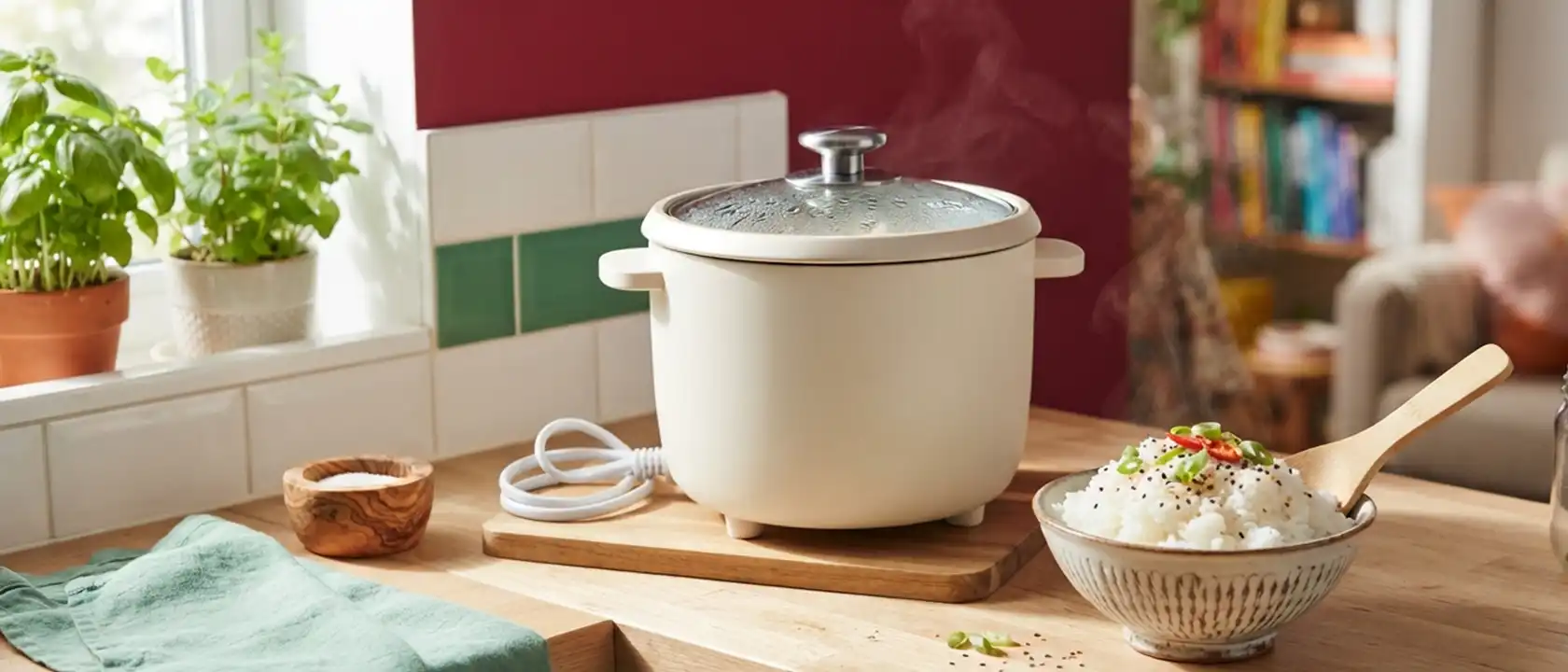
Capacity
One of the easiest mistakes when choosing a rice cooker is buying capacity for hypothetical occasions rather than normal meals. A large cooker might sound more versatile, but bigger isn’t automatically better. It occupies more space, weighs more, and may be inconvenient when you’re preparing relatively small portions most of the time.
Compact rice cookers commonly target individuals, couples, and small families. A three-cup model, for example, can be an appealing middle ground for households that cook modest batches while still wanting leftovers.
Before choosing capacity, think about your normal cooking pattern. How many people regularly eat rice? Do you prepare fresh rice for every meal, or cook enough for leftovers? Do you entertain frequently enough to justify a larger machine?
Remember that manufacturers may describe capacity using uncooked rice, cooked rice, or proprietary measuring cups. Don’t assume a “three-cup” cooker necessarily produces three standard US measuring cups of cooked rice. Check the manufacturer’s capacity explanation before buying.
For a minimalist kitchen, the ideal size is usually the smallest cooker that comfortably handles your normal maximum batch.
Small Footprint
Capacity specifications don’t tell you how much counter space an appliance occupies. Two rice cookers with similar cooking capacities can have noticeably different external dimensions. One might be tall and narrow, while another uses a broad body that takes up substantially more workspace.
Look at width and depth before focusing on height. Countertop space is generally constrained horizontally, so a relatively tall cooker with a narrow base can sometimes fit a compact kitchen more comfortably.
Height becomes important when you’re positioning the appliance underneath wall cabinets. Rice cookers release steam, and many have hinged lids that require additional vertical clearance when opened. A machine might technically fit underneath your cabinets but become inconvenient if you have to pull it forward every time you open the lid.
Measure the intended location rather than estimating it. Include clearance for opening the cooker, accessing controls, removing the inner pot, and safely allowing steam to escape. If you’re planning a broader small kitchen appliance setup, measuring every permanent countertop appliance before purchasing can prevent surprisingly common space conflicts.
Minimalist Rice Cooker Tech Considerations
Simple Controls vs Feature-Heavy Interfaces
Minimalist rice cookers generally fall into two interface categories. Basic machines might have little more than a cook switch and automatic keep-warm function. Digital models can offer several cooking programs while maintaining a relatively clean control panel. Neither approach is inherently superior.
A single-switch rice cooker can be excellent if you mostly prepare ordinary white rice. There are fewer settings to learn, and operation becomes almost automatic: measure, rinse, add water, press the control, and wait.
More advanced models make sense when you regularly cook different grains or rice varieties. Brown rice, sushi rice, mixed rice, porridge, and other foods can benefit from programs designed around different heating and soaking requirements.
The key is avoiding features that don’t match your cooking habits. Ten programs aren’t useful if you consistently select the same one. Think of controls as part of the appliance’s workflow rather than its specification sheet. The best minimalist interface is the one that gives you quick access to the functions you genuinely use.
Keep-Warm Functions
Automatic keep-warm functionality has become common in rice cookers, and it can be particularly useful for households where everyone doesn’t eat at exactly the same time. Once cooking finishes, the machine shifts to a lower-temperature mode designed to keep rice ready for serving. More sophisticated cookers may regulate warming more carefully or provide extended warming settings.
That convenience has limits. Rice quality can gradually change while sitting warm. Depending on the cooker, rice variety, and holding time, grains may become drier, firmer, or less aromatic. Keeping rice warm shouldn’t automatically become a substitute for proper food storage over extended periods.
From a minimalist perspective, however, automatic warming simplifies the cooking process because you don’t need to coordinate the rice precisely with every other component of dinner. If your household frequently eats at different times, the quality of the keep-warm system may be more valuable than several specialized cooking programs.
Advanced Cooking Technology
A clean exterior doesn’t tell you what’s happening inside the appliance. Basic rice cookers typically rely on relatively straightforward temperature-responsive mechanisms. Once the available water has been absorbed or evaporated and the temperature changes accordingly, the cooker transitions away from active cooking.
More advanced machines use microcomputer control, often described as Micom technology, to adjust cooking behavior. Some incorporate fuzzy logic that allows the cooker to respond to variations in conditions rather than relying solely on a fixed cooking cycle.
Induction-heating rice cookers take another approach by using electromagnetic induction to heat the cooking vessel. These systems can provide sophisticated temperature control, but they generally cost more than conventional heating designs.
For a simple kitchen, advanced technology is worthwhile when it improves something you notice regularly, such as rice texture, consistency across different varieties, scheduling, or warming performance. Technology that operates quietly behind a straightforward interface can actually support minimalist design. Complexity inside the machine doesn’t have to mean complexity for the person using it.
Timer
Programmable timers are worth considering even if you’re trying to minimize features. Unlike novelty cooking modes, scheduling can change how you use the appliance every day. Depending on the machine, you may be able to prepare ingredients in advance and have the cooking cycle finish around a planned mealtime. This can be particularly helpful for breakfast or busy evenings.
Controls should still remain intuitive. A timer loses much of its practical value when programming it requires repeatedly consulting an instruction manual. Look for displays that clearly differentiate current time, cooking settings, and scheduled completion. Physical buttons can sometimes be easier to operate quickly, while touch-sensitive interfaces provide a smoother exterior but may show fingerprints more readily.
Minimalism is most successful when interaction requires less thought. A well-designed timer provides meaningful automation without making the appliance feel complicated.
Minimalist Rice Cooker Design Considerations

Color and Finishes
Color plays an unusually large role in how visually prominent a small appliance feels.
White rice cookers can integrate naturally with light cabinetry and countertops, while black models may suit kitchens with darker appliances or contrasting finishes. Stainless steel can work well when refrigerators, ranges, and other equipment already use metallic surfaces. Muted shades can also work in minimalist spaces, particularly when the kitchen uses warm neutrals rather than stark white.
Consistency matters more than choosing one supposedly “minimalist” color. A bright white cooker surrounded by matte black appliances might attract more attention than a simple black model, even if the white cooker looks minimalist on its own.
Glossiness also changes the effect. Highly reflective plastic can make an appliance appear visually busier, particularly under strong kitchen lighting. Matte and satin finishes often have a quieter appearance, although surface quality varies between manufacturers.
Instead of selecting a rice cooker in isolation, consider it part of the kitchen’s overall material palette.
Rounded Shapes
Many modern compact rice cookers use curved housings rather than boxy forms with numerous external components. There’s a practical reason this style works well in minimalist kitchens. Continuous surfaces create fewer visual interruptions. Handles, hinges, control panels, and seams become less prominent when incorporated cleanly into the body. Rounded corners can also make a relatively bulky appliance appear smaller.
However, shape shouldn’t compromise usability. An elegant flush lid isn’t helpful if it’s difficult to open, and hidden controls aren’t necessarily better if labels become hard to read. The same applies to handles. Integrated carrying handles can make storage easier while preserving a streamlined appearance, but they still need to provide a secure grip.
Good industrial design balances visual restraint with obvious operation. You should be able to understand how to open, move, clean, and operate the cooker without consulting the manual every time.
Cord Storage
Power cords are one of the biggest sources of visual clutter around countertop appliances. A beautiful rice cooker can still make a kitchen look untidy when several feet of cable sit behind it. For that reason, cord design deserves attention when comparing minimalist models.
Retractable cords provide one solution. Detachable power cords can also help when storing the cooker, although you then need somewhere to keep the cable. Some appliances provide simple cord-management areas that allow excess length to remain closer to the body.
Consider outlet placement as well. If the cooker will permanently occupy a particular section of countertop, positioning it near an appropriate outlet reduces the amount of visible cable. Avoid relying on an extension cord simply to achieve a cleaner-looking arrangement unless the appliance manufacturer and electrical setup permit safe use.
Small details such as cord placement rarely appear at the top of buying guides, but they can noticeably affect how organized a kitchen feels.
Minimalist Rice Cooker Practical Considerations
Easy-to-Clean Components
A simple-looking appliance that requires complicated maintenance misses much of the point. Rice cookers regularly encounter starch, condensation, and steam. Depending on the design, residue can accumulate around the inner lid, steam vent, gasket, condensation collector, or upper rim.
Removable components make these areas easier to access. An inner lid or steam vent that can be detached and washed separately can prevent dried starch from accumulating in difficult corners.
The inner pot deserves particular attention because you’ll handle it after nearly every use. Nonstick coatings can make rice release and cleanup easier, but they generally require gentler utensils and cleaning methods to avoid scratching. Stainless steel avoids a traditional nonstick coating but can require more soaking or scrubbing when rice sticks.
Neither material is automatically right for every household. The better choice depends on whether you prioritize effortless cleanup, material preferences, durability, or replacement availability. When evaluating rice cooker cleaning and maintenance, look beyond the bowl. The easiest machine to live with is one whose frequently dirty parts can actually be reached.
Multi-Purpose Use
Countertop minimalism becomes much easier when one appliance can handle several foods you regularly prepare. Some rice cookers can make oatmeal, porridge, quinoa, mixed grains, or steamed foods in addition to rice. More advanced machines may include dedicated programs for these foods, while simple models can sometimes prepare them with manual adjustments.
Multifunctionality can reduce appliance clutter, but there’s an important distinction between useful versatility and feature inflation. A steaming basket might genuinely replace a separate steamer if you regularly prepare vegetables alongside rice. A porridge setting could be valuable if oatmeal is part of your breakfast routine. An obscure specialty program that you never use adds little practical value.
Evaluate additional functions by asking what other kitchen task they could realistically replace. The goal isn’t to purchase the appliance with the longest menu. It’s to select one that performs enough of your recurring cooking tasks to justify keeping it accessible.
Inner Pot
The inner cooking vessel has a greater impact on everyday ownership than many cosmetic features. Thickness affects how the pot handles heat, while material and coating influence durability, weight, food release, and cleaning. Some premium rice cookers use multilayered vessels engineered for more controlled heat distribution.
Before buying, check how the manufacturer recommends cleaning the pot and what utensils are safe to use. If the bowl has a nonstick coating, metal utensils are typically best avoided unless the manufacturer specifically states otherwise. Scratching or damaging the cooking surface can shorten its useful life.
Replacement availability matters, too. A rice cooker might last many years while its inner pot eventually becomes worn or damaged. Being able to purchase an official replacement can keep the entire appliance out of the waste stream. That makes replacement parts an overlooked element of minimalist ownership. Buying fewer appliances works best when the ones you choose can remain useful for a long time.
Storage
Not every minimalist kitchen needs a rice cooker permanently displayed. If you cook rice only occasionally, storing the appliance between uses may produce a cleaner and more functional countertop. In that situation, weight, handles, cord management, and cabinet dimensions become especially important.
Measure your intended storage area before buying. Pay attention to shelf depth and opening width rather than assuming a compact-looking appliance will fit. Also consider what has to be stored with it. Measuring cups, paddles, steaming baskets, detachable cords, and other accessories can create their own clutter when they don’t fit inside the appliance.
A particularly practical design allows at least some accessories to remain inside the pot when the machine is stored. If you use the cooker several times per week, permanent countertop placement may make more sense. Minimalism shouldn’t make everyday cooking inconvenient merely for the sake of having an empty counter.
Don’t Choose a Rice Cooker Based on Appearance Alone
Aesthetic kitchen appliances have become increasingly popular, but a rice cooker is still a cooking appliance first. An attractive exterior can’t compensate for unevenly cooked rice, awkward cleaning, an unreliable lid, confusing controls, or unsuitable capacity.
Start with performance requirements. Decide what rice varieties you cook, how much you normally prepare, how often you use the appliance, and which secondary functions genuinely matter. Then narrow those suitable models according to size and appearance.
Independent testing can be useful because rice cooker performance isn’t always obvious from product specifications. Current kitchen testing publications compare factors such as cooking consistency, ease of use, cleaning, size, and performance across different rice types.
Long-term ownership also matters. Warranty coverage, replacement inner pots, removable components, and accessible customer support may not affect how the cooker looks on day one, but they can determine how long it remains in your kitchen.
Designing a Cleaner Countertop Around Your Rice Cooker
Even a compact appliance can create clutter when its surrounding space isn’t planned.
Give frequently used equipment defined locations instead of moving it around the kitchen. If the rice cooker stays out permanently, position it somewhere that provides safe steam clearance while keeping your main food-preparation area open.
Avoid surrounding it with accessories. Rice paddles, measuring cups, seasonings, and containers don’t necessarily need to remain beside the machine simply because they’re used together.
Visual repetition also helps. Appliances with related finishes can create a calmer countertop even when several items remain visible.
For kitchens with extremely limited workspace, prioritize appliances according to frequency of use. A rice cooker used five times a week deserves accessible space more than a specialty appliance used once a month.
This approach turns minimalist kitchen design into a practical system rather than a decorating style. The goal is not an artificially empty countertop. It’s a countertop where the objects that remain are useful, intentional, and easy to access.
The Best Minimalist Design Is the One You Barely Think About
The strongest minimalist rice cooker designs disappear into your routine. They don’t require complicated setup, dominate the countertop, or create unnecessary cleaning work. You measure your rice and water, start the machine, and get predictable results.
For most simple kitchens, that means prioritizing an appropriate capacity, compact footprint, straightforward interface, easy-to-clean components, and restrained exterior design. Advanced features such as fuzzy logic, timers, specialized rice programs, or induction heating can still make sense when they solve a genuine cooking need.
Avoid treating minimalism as an aesthetic specification alone. A tiny appliance isn’t minimalist if it’s too small for your household, and a sleek touchscreen isn’t simple if basic functions are difficult to access.
The right minimalist rice cooker should reduce friction as well as visual clutter. Choose according to how you actually cook, give the appliance a deliberate place in your kitchen, and prioritize durability over features you’ll rarely touch. That combination creates a simpler kitchen without making everyday meals more complicated.

