

8 Factors Affecting a Rice Cooker’s Energy Consumption
Table of Contents
Rice cookers are often considered one of the most energy-efficient kitchen appliances because they automate cooking and prevent wasted heat. However, not all rice cookers consume electricity in the same way. Two households might cook the same amount of rice and end up using noticeably different amounts of power depending on the appliance, settings, and cooking habits involved.
When people look at rice cooker energy consumption, they usually focus on wattage. While wattage matters, it’s only one piece of a much larger picture. Cooking duration, heating technology, insulation quality, keep warm settings, and even the temperature of your kitchen can influence how much electricity your rice cooker uses.
Understanding these factors can help you lower electricity costs, choose a more efficient appliance, and get better long-term value from your rice cooker.
How Much Electricity Does a Rice Cooker Use?
Most household rice cookers consume between 300 and 1,200 watts while actively cooking. Smaller units designed for one or two people typically operate at the lower end of the range, while larger family-sized or commercial-style models use significantly more power.
However, electricity consumption isn’t determined solely by wattage. A 1,000-watt rice cooker that finishes cooking quickly may use less total energy than a 500-watt unit that requires a much longer cooking cycle.
Electricity usage is measured in kilowatt-hours (kWh), which combines power and time. For example, a 700-watt rice cooker operating for one hour consumes 0.7 kWh. If local electricity costs are $0.15 per kWh, that cooking cycle costs just over ten cents.
Because rice cookers usually operate for less than an hour per batch, their actual operating cost is often surprisingly low. What tends to increase annual energy consumption isn’t the cooking process itself but the extended use of keep-warm functions.
Understanding Rice Cooker Wattage and Power Consumption
Many buyers assume a lower-wattage rice cooker automatically saves electricity. In reality, efficiency depends on how effectively that power is used.
Think of wattage as the speed at which energy is consumed. A higher wattage appliance draws more power per minute, but if it completes cooking much faster, total energy use may end up being similar or even lower.
Modern premium rice cookers often have higher rated wattage because they use advanced heating systems designed to rapidly bring water to temperature. Once cooking begins, intelligent control systems regulate power output and reduce unnecessary energy consumption. Looking only at the wattage label ignores cooking algorithms, insulation quality, and heat retention capabilities.
Small rice cookers usually operate between 300 and 500 watts. Mid-sized household models commonly range from 500 to 900 watts. Larger units often exceed 1,000 watts, particularly when pressure cooking or induction heating features are included.
The increase in wattage reflects the larger cooking chamber and greater volume of water that must be heated. However, these larger models are not necessarily less efficient. When fully utilized, they can be more efficient on a per-serving basis than repeatedly running a smaller unit.
Factors That Affect Rice Cooker Energy Consumption
Rice Cooker Capacity
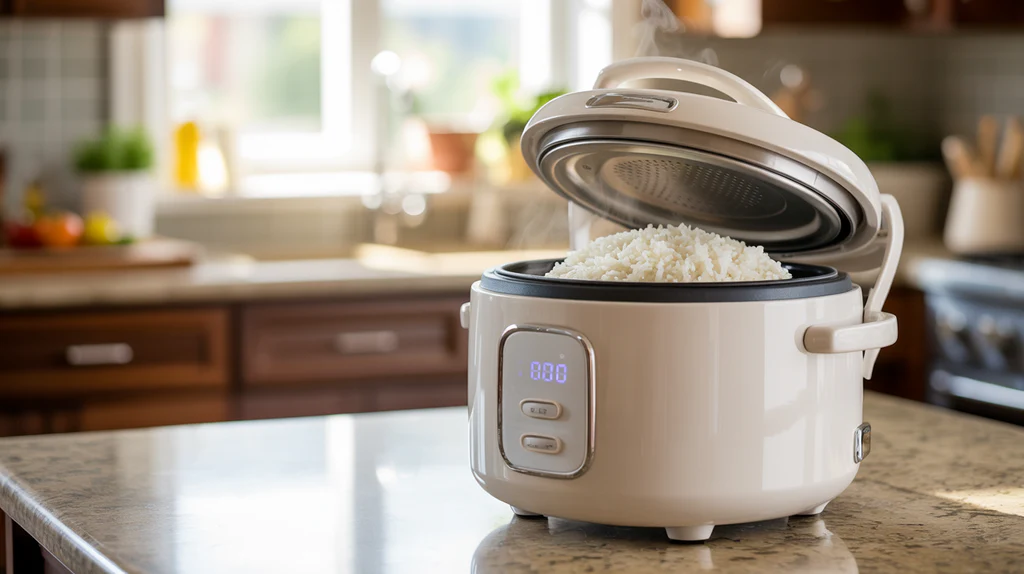
Rice cooker capacity influences energy usage in ways that aren’t always obvious. A larger cooker naturally requires more energy to heat its inner pot and cooking chamber. However, efficiency depends on how closely the batch size matches the appliance’s intended capacity.
Cooking one cup of rice in a ten-cup rice cooker often wastes energy because the appliance still needs to heat a large cooking environment. Meanwhile, cooking eight cups in the same unit may be highly efficient because fixed heating costs are spread across a greater quantity of food.
This is why households should select a rice cooker that aligns with their typical cooking volume. Oversized appliances frequently consume unnecessary energy during routine use, while undersized units may require multiple cooking cycles that ultimately use more electricity.
Cooking Time
Cooking time has a direct influence on rice cooker electricity usage. White rice generally cooks faster because the bran layer has been removed during processing. Many rice cookers can complete white rice cycles within 20 to 40 minutes.
Brown rice requires substantially longer cooking times. The outer bran layer slows water absorption and demands extended heating. Some brown rice programs run for 60 to 90 minutes, depending on the model. Even if power draw remains similar, the longer cooking duration increases overall energy consumption.
Quick-cook settings also reduce total cooking time by applying more aggressive heating strategies. These programs often increase power output initially but shorten the overall cycle. In many cases, the reduced cooking duration offsets the higher power demand, making quick-cook modes surprisingly efficient. The tradeoff is that rice texture may differ slightly from standard cooking programs.
Heating Technology
Traditional rice cookers rely on a heating plate positioned beneath the inner pot. Heat transfers upward through direct contact. This design is affordable and reliable, but some energy is lost through uneven heat distribution. Hot spots may develop, causing the appliance to cycle repeatedly to maintain target temperatures.
Induction rice cookers, on the other hand, are among the most efficient designs currently available. Rather than heating a plate, induction systems generate heat directly within the cooking vessel through electromagnetic energy. This allows faster and more precise temperature control. Because heat is created exactly where it’s needed, energy losses are reduced. Cooking performance improves while electricity usage remains highly controlled.
Although induction rice cookers often carry higher purchase prices, their efficiency, consistency, and advanced cooking performance make them attractive for frequent rice consumers.
Pressure rice cookers increase internal pressure to raise cooking temperatures. Higher temperatures speed starch gelatinization and can shorten cooking times for certain rice varieties. While these units may draw significant power during operation, the reduced cooking duration often improves overall efficiency.
Keep Warm Mode
Many people assume cooking rice consumes the most electricity. In reality, keep warm mode can become the largest contributor to annual energy use. Modern rice cookers maintain temperatures between approximately 140°F and 170°F. While power draw during keep warm mode is much lower than active cooking, the function may operate for several hours at a time.
A rice cooker left on keep warm for eight hours every day can consume more electricity over the course of a year than the actual cooking cycles themselves. For households focused on energy savings, turning off keep warm mode once meals are finished can significantly reduce electricity consumption.
Thermal Insulation
Thermal insulation is one of the least discussed yet most important factors affecting rice cooker energy consumption. Well-insulated rice cookers retain heat effectively, reducing the need for frequent reheating cycles. Better insulation helps maintain cooking temperatures with less energy input and improves keep warm efficiency.
Premium rice cookers often feature multi-layer construction, insulated lids, and advanced sealing systems. These design elements reduce heat loss and improve overall energy performance. Lower-cost models frequently have thinner walls and less effective sealing, allowing heat to escape more rapidly. The appliance then compensates by activating the heating system more often.
Rice Quantity and Water Levels
The amount of rice and water inside the cooker influences energy requirements. Larger quantities require additional heating because more mass must be brought to cooking temperature. However, energy use doesn’t increase proportionally. Doubling the amount of rice rarely doubles electricity consumption.
Water levels also matter. Excess water increases heating demand because additional energy is required to raise the temperature and maintain boiling conditions throughout the cooking cycle. Accurate measuring isn’t only important for cooking quality. It can also improve energy efficiency.
Smart Features and Fuzzy Logic Technology
Advanced rice cookers increasingly use fuzzy logic technology and computerized sensors. These systems continuously monitor temperature changes and adjust heating patterns throughout cooking. Instead of simply switching on and off, the appliance fine-tunes energy delivery based on real-time conditions. The result is more efficient heat management and better cooking consistency.
Some consumers assume smart features automatically increase electricity usage. In practice, intelligent controls often reduce waste by avoiding excessive heating and unnecessary temperature fluctuations.
Environmental Factors
Kitchen Temperature
Ambient temperature affects how hard a rice cooker must work. In colder environments, more heat escapes into the surrounding air. The appliance may need longer heating cycles to maintain target temperatures. Warmer kitchens generally improve efficiency because less heat is lost during operation.
Altitude
High-altitude locations experience lower atmospheric pressure, which alters boiling temperatures. Water boils at lower temperatures as elevation increases. Some rice cookers compensate through longer cooking times or modified heating cycles. These adjustments can influence total energy consumption. While the effect may be modest for most households, it becomes noticeable in mountainous regions.
The Real Cost of Running a Rice Cooker
For most American households, rice cookers remain inexpensive to operate. A typical household cooking rice several times per week may only spend a few dollars per month on electricity. The exact amount depends on local utility rates, cooking frequency, appliance efficiency, and keep warm habits.
When compared with stovetop cooking, rice cookers often reduce energy waste because they automatically stop active heating when cooking is complete. They also eliminate the need for constant monitoring, reducing the likelihood of overcooking and wasted energy.
How to Reduce Rice Cooker Electricity Usage

Improving rice cooker efficiency doesn’t require major lifestyle changes.
- Using the correct rice-to-water ratio prevents unnecessary heating.
- Matching appliance size to household needs reduces wasted capacity.
- Turning off keep warm mode when it’s no longer needed can significantly lower annual energy consumption.
- Regular cleaning also matters. Dirt, residue, and mineral buildup can interfere with heat transfer efficiency, causing longer cooking cycles.
- For frequent rice eaters, investing in a well-insulated induction rice cooker may deliver meaningful energy savings over the appliance’s lifespan.
Choosing an Energy-Efficient Rice Cooker
The most energy-efficient rice cooker isn’t necessarily the one with the lowest wattage rating. Instead, consumers should evaluate overall design quality, insulation performance, heating technology, cooking algorithms, and intended usage patterns.
Induction heating models generally offer the best efficiency. Strong insulation reduces heat loss. Intelligent cooking systems improve temperature management. Appropriate capacity prevents wasted energy. When these factors work together, the result is lower electricity consumption and consistently better cooking performance.
Frequently Asked Questions
Does a rice cooker use a lot of electricity?
No. Most rice cookers consume relatively little electricity compared to ovens, electric ranges, dryers, or space heaters. A typical cooking cycle often costs only a few cents in electricity. Long-term energy use is more heavily influenced by how frequently the keep warm mode is used rather than the cooking cycle itself.
Is a rice cooker more energy efficient than cooking rice on the stove?
In many situations, yes. Rice cookers are designed specifically for rice preparation and automatically regulate heat throughout the cooking process. Stovetop cooking can waste energy through excess burner use, prolonged boiling, or human error. Rice cookers generally provide more consistent efficiency because they shut down active heating when cooking is complete.
Does keep warm mode use a lot of electricity?
Keep warm mode uses much less power than active cooking, but duration matters. A rice cooker left on keep warm for several hours every day can consume a significant amount of electricity over the course of a year. Limiting unnecessary keep-warm time is one of the easiest ways to reduce rice cooker energy consumption.
Are induction rice cookers more energy efficient?
Generally, yes. Induction heating transfers energy directly into the cooking vessel, reducing heat loss and improving temperature control. This allows more of the consumed electricity to be used for cooking rather than being lost to the surrounding environment.
Does cooking more rice use more electricity?
Yes, but not proportionally. Cooking larger batches requires additional energy because more food and water must be heated. However, the increase is usually smaller than many people expect because some energy costs remain fixed regardless of batch size. This means larger batches can often be more efficient on a per-serving basis.
Should I unplug my rice cooker when not in use?
If your rice cooker remains plugged in, it may draw a small amount of standby power depending on the model. Unplugging the appliance when it’s not being used can eliminate this standby consumption, although the savings are usually modest compared to reducing keep warm usage.

