How to Match Your Rice Cooker to Your Kitchen Theme
A rice cooker is one of those appliances that can easily become a permanent countertop fixture. If you cook rice several times a week, putting the cooker into a cabinet after every use rarely makes sense. That means its appearance can have a bigger impact on your kitchen than you might expect.
Learning how to match your rice cooker to your kitchen theme isn’t simply a matter of choosing your favorite color. The appliance needs to work with the visual language already established by your cabinets, countertops, hardware, backsplash, and other appliances. Its proportions also matter. A bulky cooker can overwhelm a small counter, while an ultra-compact model may look visually lost in a spacious kitchen.
The goal is to find a rice cooker that feels like it belongs in the room without sacrificing the capacity, cooking functions, or convenience you actually need.
Start With Your Kitchen’s Existing Design Language
Before comparing rice cooker colors and finishes, look at the kitchen as a whole. Most kitchens have a visual language created by repeated materials, shapes, colors, and details.
A contemporary kitchen might feature flat-panel cabinetry, clean lines, stainless steel appliances, and minimal decoration. A farmhouse kitchen could combine painted cabinets, natural wood, warm metals, and traditional details. Scandinavian-inspired spaces often rely on pale wood, neutral colors, simplicity, and practical objects that don’t create unnecessary visual clutter.
Your rice cooker doesn’t need to match every element. In fact, trying to match everything exactly can make a room feel overly coordinated. Instead, identify two or three dominant characteristics.
If your kitchen is filled with straight lines and smooth surfaces, a streamlined rice cooker will generally integrate more naturally than a heavily detailed appliance. If the room relies on warm woods and soft colors, an appliance with a warmer neutral finish may feel more comfortable than glossy black plastic.
Think of the rice cooker as another object within the kitchen’s existing design vocabulary rather than an isolated purchase.
Decide Whether You Want the Rice Cooker to Blend In or Stand Out
One of the most useful decisions you can make early is whether the rice cooker should visually disappear into the kitchen or become a deliberate accent.
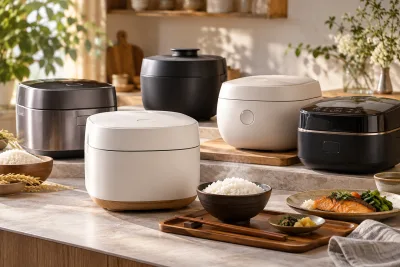
For a blended look, choose a color already present in the room. A white rice cooker can work particularly well with white cabinetry, light countertops, or other white small appliances. Stainless steel can visually connect the cooker with a refrigerator, range, dishwasher, or metallic hardware. Black can create a similar relationship in kitchens with dark fixtures, black cabinet pulls, or black appliances.
A contrasting rice cooker takes a different approach. In a neutral kitchen, a muted green, blue, red, or other colored appliance can become a small focal point. This strategy works particularly well when the accent color appears elsewhere, such as in cookware, bar stools, dish towels, ceramics, or decorative objects.
Contrast works best when it looks intentional. A single bright appliance surrounded by unrelated colors can feel accidental. Repeating its color elsewhere creates visual continuity.
Match the Finish, Not Just the Color
Two appliances can technically be the same color and still look completely different because of their finishes.
Glossy surfaces reflect light and tend to attract more visual attention. They can work well in polished contemporary kitchens, especially when other appliances or cabinetry have similarly reflective surfaces.
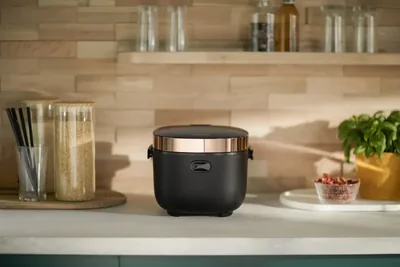
Matte finishes create a softer effect. A matte black or off-white rice cooker can fit naturally into minimalist, Scandinavian, industrial, or modern kitchens where understated surfaces dominate.
Stainless steel is especially versatile because it can connect visually with major kitchen appliances. However, pay attention to how much metal is visible. A rice cooker with a small stainless steel panel looks very different from one with a predominantly metallic body.
You should also consider maintenance. Highly reflective surfaces can make fingerprints, water spots, and cooking residue more visible. If your rice cooker gets used daily, a finish that disguises minor marks may keep the countertop looking cleaner between wipe-downs.
Choose a Rice Cooker for a Modern Kitchen
Modern kitchens generally benefit from appliances with restrained shapes, simple controls, and minimal visual clutter.
Look for rice cookers with smooth bodies, integrated handles, compact control panels, and neutral finishes. Black, white, gray, and stainless steel are particularly easy to incorporate.
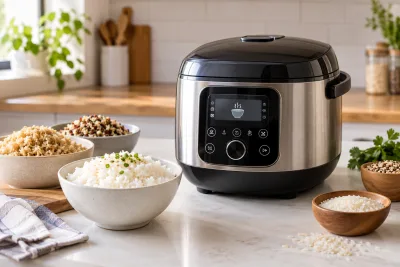
Digital rice cookers can fit this aesthetic well when their displays and buttons are organized cleanly. A model with a simple front-facing screen often looks more cohesive beside modern coffee makers, air fryers, and other countertop appliances than a cooker covered in brightly colored labels.
Shape matters too. Rounded rice cookers can still work in modern kitchens, but overly decorative styling may compete with the clean geometry of the space.
If you’re trying to maintain an especially streamlined countertop, pay close attention to the power cord, steam vent, and lid mechanism. These practical details affect where the cooker can sit and how tidy the surrounding area will look.
Complement a Minimalist Kitchen Without Adding Clutter
Minimalist kitchens make every visible object more noticeable. Because there are fewer items competing for attention, an appliance that doesn’t fit the space can stand out immediately.
Simple rice cooker designs are usually the easiest choice. Look for a restrained color palette, limited branding, uncomplicated controls, and a body without unnecessary decorative details.
Proportion is particularly important here. An oversized appliance can undermine the sense of open counter space that minimalist kitchens depend on. Choosing the smallest capacity that comfortably meets your household’s needs can preserve more visual breathing room.
Cord management also becomes more significant. Positioning the rice cooker near an outlet can prevent a long cable from running across an otherwise uncluttered counter.
If you’re building a kitchen around simplicity, you may also want to consider how minimalist rice cooker designs can reduce visual noise while still providing the cooking functions you use regularly.
Bring Warmth to Farmhouse and Rustic Kitchens
Farmhouse and rustic kitchens often use materials that feel warm, familiar, and tactile. Wood, painted cabinetry, stone, ceramics, and aged or brushed metals are common.
A bright, futuristic-looking appliance can create a sharp visual interruption in this setting. Softer finishes tend to integrate more comfortably.
Cream, off-white, muted green, soft gray, and warm metallic accents can complement the relaxed character of these kitchens. A simple white cooker can also work, particularly when paired with white or cream cabinetry.
Placement can help bridge the gap between modern technology and traditional design. Instead of placing the cooker alone on an empty counter, positioning it near wooden cutting boards, ceramic containers, or other frequently used cooking tools can make it feel more connected to its surroundings.
Avoid surrounding the appliance with purely decorative objects, however. Rice cookers release steam, and their immediate surroundings should remain practical, heat-tolerant, and easy to clean.
Keep Scandinavian-Inspired Kitchens Light and Simple
Scandinavian kitchen design typically emphasizes functionality, simplicity, natural materials, and light. A rice cooker fits surprisingly well into this philosophy when its design feels practical rather than ornamental.
White, cream, pale gray, and other light neutrals are natural choices. A matte finish can complement light wood cabinets, open shelving, and understated hardware without creating excessive contrast. Black can also work when the kitchen already uses black as a deliberate accent through faucets, pendant lights, window frames, or cabinet hardware.
The appliance’s physical form matters as much as its color. A compact cooker with clean controls and a simple silhouette will generally feel more appropriate than a large model with numerous contrasting buttons and labels.
You don’t necessarily need to hide technology in a Scandinavian-inspired kitchen. The better approach is often to choose useful objects that are visually quiet enough to remain on display.
Use Color Carefully in Retro and Eclectic Kitchens
Retro and eclectic kitchens give you more freedom to treat a rice cooker as part of the room’s personality.
Pastel colors can complement mid-century and retro-inspired interiors, while saturated colors may work well in eclectic kitchens that already contain expressive artwork, patterned tiles, or colorful cookware.
Shape becomes particularly useful here. A rounded rice cooker may complement curved refrigerators, kettles, toasters, and other appliances with vintage-inspired forms.
The challenge is avoiding visual competition. An eclectic room doesn’t mean every object needs to make a statement. If the backsplash, cabinets, and accessories are already colorful, a neutral rice cooker can provide balance. Conversely, if the architecture and cabinetry are relatively restrained, the cooker can become one of the smaller elements that introduces personality.
Look at the distribution of color throughout the room rather than evaluating the appliance by itself.
Coordinate Your Rice Cooker With Other Countertop Appliances
Matching a rice cooker directly to the kitchen isn’t your only option. Sometimes the easiest way to create cohesion is to coordinate your countertop appliances with one another.
If your toaster, coffee maker, kettle, and air fryer are all matte black, adding another matte black appliance creates a recognizable family of objects. The same principle works with stainless steel or white appliances.
They don’t need to come from the same manufacturer. Consistency in finish and general design style is usually enough. However, avoid buying an unsuitable rice cooker solely because it matches your toaster. Capacity, cooking performance, cleaning requirements, and functionality should still come first.
When an ideal model doesn’t perfectly match the rest of your appliances, placement can reduce the visual difference. Separating appliances into functional zones often looks more intentional than lining several mismatched machines side by side.
Pay Attention to Size and Visual Weight
Capacity affects more than how much rice you can cook. It also changes how the appliance occupies your countertop.
Large-capacity cookers tend to have greater visual weight because of their width, height, and rounded bodies. In a spacious kitchen, that may not be a problem. On a narrow apartment counter, the same appliance can dominate the work surface.
Before purchasing, check the product’s external dimensions rather than relying solely on cup capacity. Measure the intended countertop location and consider the space required to open the lid fully.
You also need room for ventilation. A rice cooker shouldn’t be squeezed underneath a low cabinet if steam will repeatedly hit the underside of the cabinetry.
A smaller cooker can be a better design choice for one- or two-person households, but don’t downsize purely for appearance if you regularly cook larger batches. An appliance that looks perfect but can’t meet your cooking needs isn’t a good match.
Consider Where the Rice Cooker Will Actually Sit
Placement has a major influence on how well any countertop appliance integrates into a kitchen.
Start with workflow. Ideally, the rice cooker should be near the areas where you wash, prepare, and serve rice without interfering with your primary prep space.
Then consider the background behind it. A black rice cooker may almost disappear against a dark backsplash but create strong contrast against white tile. A white appliance can have the opposite effect.
Corners can work well for rice cookers because they use countertop areas that might otherwise be underutilized. However, make sure you can open the lid easily and move the cooker when it needs cleaning.
Avoid placing it directly beneath cabinetry if steam can’t escape safely. Repeated exposure to moisture can affect nearby surfaces over time. You may need to pull the appliance forward during cooking even if it normally sits farther back on the counter.
Don’t Sacrifice Function for Appearance
Kitchen aesthetics matter, but a rice cooker is still a working appliance.
Start by identifying how much rice you normally prepare. Then consider the functions you’ll genuinely use. A basic model may be sufficient if you primarily cook white rice, while households that regularly prepare brown rice, mixed grains, porridge, or other dishes may benefit from additional programs.
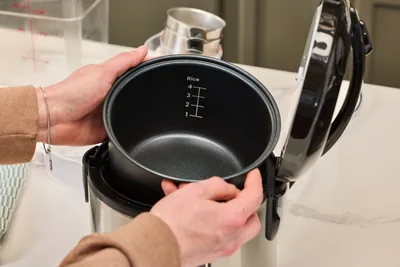
Cleaning also deserves consideration. Removable inner lids, detachable steam components, and accessible condensation areas can make routine maintenance easier. If the cooker is frustrating to clean, its attractive exterior won’t compensate for the inconvenience. The same applies to controls. A sleek interface may look impressive, but it should still be readable and intuitive enough for everyday use.
Use design as a filter after you’ve established your practical requirements. This approach prevents you from choosing an attractive appliance that eventually gets replaced because it doesn’t perform the job you bought it to do.
Think About How the Rice Cooker Looks When It’s in Use
Product photos usually show appliances in their cleanest, most compact state. Your rice cooker may look quite different during actual cooking.
The lid might need significant clearance to open. Steam may require you to pull the unit away from the wall. A removable condensation collector could protrude from the back. Accessories such as rice paddles, measuring cups, and steaming baskets also need somewhere to go.
Think about these operational details before deciding that a particular model is perfect for a specific countertop location. If you want a visually organized kitchen, decide where the accessories will be stored. A nearby drawer is usually cleaner than leaving the measuring cup and paddle beside the cooker.
Considering the appliance in use rather than only at rest gives you a much more realistic picture of how it will affect your kitchen.
Use the Countertop as Part of the Design
The relationship between the rice cooker and the countertop can determine whether the appliance feels integrated or visually disconnected.
On white quartz or marble-look counters, both white and dark appliances can work. White creates a low-contrast effect, while black produces a sharper, more graphic look.
Wood countertops introduce warmth, making cream, white, muted colors, and some stainless steel finishes particularly effective. Dark stone countertops can visually absorb black appliances, while lighter appliances create contrast.
You can also use a simple appliance tray or heat-resistant mat when appropriate, especially if you want to visually define a small appliance zone. Choose something that complements the countertop rather than introducing another competing pattern.
Remember that the surface around a rice cooker needs frequent cleaning. Keep decorative styling simple enough that wiping up condensation, starch, or occasional spills doesn’t become a chore.
Create Cohesion Through Repetition Rather Than Exact Matching
A well-designed kitchen rarely depends on every object being the same color. Repetition is usually more effective than exact matching.
Suppose you have a white rice cooker in a kitchen with wood cabinetry. It can still look completely intentional if white appears in the backsplash, dishes, pendant shades, or countertops. The same principle applies to black, stainless steel, brass-toned details, or accent colors.
This gives you much more flexibility when shopping because rice cooker manufacturers don’t necessarily offer every model in every finish. Instead of searching endlessly for an exact cabinet-color match, look for a finish that repeats an element already visible elsewhere in the kitchen.
Repetition creates visual relationships. Those relationships are what make separate objects feel like parts of the same room.
Make Long-Term Style Part of the Decision
Kitchen trends change faster than most appliances need to be replaced. If you’re buying a quality rice cooker that you expect to use for years, consider whether you’ll still like its appearance if your kitchen decor changes.
Neutral colors such as white, black, gray, and stainless steel generally offer the most flexibility. They can transition between several kitchen styles and are easier to coordinate if you repaint cabinets or replace other countertop appliances later.
That doesn’t mean colorful rice cookers are a poor choice. If a particular color reflects your personal style rather than a temporary trend, it may remain appealing for years.
The distinction is useful. Choosing something because you genuinely enjoy it is different from buying it solely because it’s currently fashionable. A kitchen should still feel personal. Longevity doesn’t require making every appliance neutral.
How to Match Your Rice Cooker to Your Kitchen Theme Successfully
The best way to match your rice cooker to your kitchen theme is to consider the appliance as both a cooking tool and a permanent visual element. Start with capacity and cooking functions, then narrow your options according to color, finish, shape, scale, and the location where the cooker will actually be used.
Look for visual relationships rather than perfect matches. A stainless steel cooker can connect with major appliances, a white model can echo countertops or cabinetry, and a colorful cooker can repeat an accent used elsewhere in the room.
Most importantly, choose a design that works when the rice cooker is actually cooking, not just when it’s photographed on an empty counter. When appearance, placement, and everyday functionality support one another, the rice cooker feels less like an appliance that happens to be sitting out and more like a natural part of the kitchen.