Rice Cooker Design: Award Winners and Standouts
Rice cookers used to follow a fairly predictable formula: a round body, hinged lid, inner pot, control panel, and carrying handle. That basic architecture still works, but designers have increasingly treated the rice cooker as something more than a purely functional appliance.
Some of the most interesting examples of modern rice cooker design have earned recognition from organizations such as the Red Dot Design Award, iF Design Award, and Japan’s Good Design Award.
These products show that good design isn't simply about making an appliance attractive. It can improve interaction, simplify controls, rethink heating systems, reduce visual clutter, and make a rice cooker easier to incorporate into the kitchen.
Looking at these award winners and other design standouts reveals where rice cooker design has been and where it may be heading.
What Makes a Rice Cooker Design Stand Out?
A beautifully styled rice cooker can attract attention, but appearance alone doesn't make it a good product design. Rice cookers present designers with an unusual combination of technical and practical challenges.
The appliance needs to manage heat and moisture precisely while protecting users from hot surfaces and steam. The lid has to open easily without becoming cumbersome. The inner pot should be straightforward to remove, carry, wash, and reinstall. Controls need to communicate increasingly complicated cooking programs without overwhelming the person standing in front of them.
Then there's the countertop problem. Unlike a blender that may spend much of its life inside a cabinet, a rice cooker is often left out because households use it frequently. Its size, shape, materials, and visual presence therefore matter.
Award-winning designs tend to address several of these challenges simultaneously. Instead of adding decorative details after the engineering is finished, they make functionality part of the appliance's visual identity.
Zojirushi ZUTTO: Minimalism Before It Became the Trend
One particularly influential example is the Zojirushi ZUTTO IH Rice Cooker, designed by Japanese product designer Fumie Shibata. Released in 2004, the ZUTTO received a Good Design Award that same year.
Its significance becomes clearer when viewed against feature-heavy rice cookers of the period. Many appliances emphasized technology through visible buttons, displays, labels, and bulky forms. ZUTTO took almost the opposite approach.
The ZUTTO concept treated the rice cooker as a basic household tool rather than a technological centerpiece. Its functions were deliberately streamlined around usability, while its understated form allowed it to fit naturally into different interiors.
That philosophy remains highly relevant.
Modern appliances sometimes suffer from feature overload. Adding another cooking program is relatively easy. Making 15 programs understandable without covering an appliance in buttons is considerably harder.
ZUTTO demonstrated that reducing visual and functional complexity could itself be a sophisticated design decision.
It also helped establish an approach that appears frequently in contemporary kitchen appliances: technology that doesn't constantly advertise itself.
Zojirushi STAN.: Making the Rice Cooker Part of the Kitchen
Zojirushi continued exploring understated appliance design with its STAN. series. Designed in collaboration with Japanese design studio TENT, the STAN. Rice Cooker received a Good Design Award in 2019.
The design illustrates an important change in how manufacturers think about countertop appliances. A rice cooker no longer needs to look like an isolated piece of equipment.
Instead, manufacturers increasingly develop shared visual languages across kettles, cookers, coffee makers, and other appliances. Consistent proportions, materials, colors, and controls can make separate products feel like parts of the same kitchen environment.
That approach is especially useful in smaller kitchens where appliances remain visible. A visually restrained cooker can coexist more comfortably with other objects instead of dominating the countertop.
For consumers interested in matching appliances to their space, understanding how to choose a rice cooker for your kitchen aesthetic can therefore be almost as relevant as comparing capacities and cooking programs.
BALMUDA The Gohan: Reimagining the Cooking System
Some standout rice cooker designs begin with appearance. BALMUDA The Gohan began with a more fundamental question: could the cooking mechanism itself be reconsidered?
The appliance uses two interior pots stacked together. Water placed between them generates steam, creating a cooking method intended to heat the rice gently while preserving the structure of individual grains.
Its exterior references traditional Japanese rice-cooking vessels while presenting them through a distinctly contemporary form. The design received Red Dot recognition.
The Gohan demonstrates why industrial design can't be separated neatly from engineering.
Changing the cooking system affects almost everything else. It influences the size and proportions of the appliance, how the user adds water, how components fit together, how the cooker is cleaned, and how the product communicates its difference from conventional machines.
BALMUDA's approach also shows how traditional cooking practices can influence contemporary appliance design without simply copying historical forms.
The visual reference provides familiarity. The internal architecture introduces something new.
This balance between recognizable objects and unconventional engineering is one reason the most memorable rice cooker designs often feel both familiar and unusual.
Philips Mini Rice Cooker Viva Collection: Hiding the Technology
Displays present an interesting problem for appliance designers.
A large screen can make a cooker easier to operate while it's running, but the same screen can make the appliance look unnecessarily technical when it's switched off.
The Philips Mini Rice Cooker Viva Collection addressed that tension by integrating its display beneath the glass surface of the lid. The display becomes visible when the appliance is activated but recedes when it isn't being used. The cooker received a Red Dot Product Design award in 2018.
Its gently curved silhouette and recessed lid also reduce the visual bulk associated with traditional rice cookers.
This disappearing-interface concept has become increasingly relevant as appliances gain more electronic functions.
Consumers want timers, programs, temperature controls, and status information. But displaying every capability permanently can create visual noise.
A concealed display provides a compromise. Information appears when it's useful and disappears when it isn't.
That principle extends well beyond rice cookers. Ovens, induction cooktops, refrigerators, and other appliances increasingly use integrated touch surfaces and hidden displays to make complex electronics feel less intrusive.
Philips 5000 Series: Making More Controls Feel Simpler
Another Philips design illustrates the other side of the interface challenge.
The Rice Cooker 5000 Series IH model combines induction heating with multiple cooking programs and selectable rice textures. Philips describes five texture settings and 18 optimized cooking programs, alongside touch-button controls. The product has also received an iF Design Award.
More capability usually creates more interface complexity. If every function receives its own physical button, control panels quickly become crowded.
Modern rice cooker design therefore increasingly depends on information architecture. Designers must decide which settings deserve immediate access, which can sit inside menus, and how users can understand their selections without repeatedly checking a manual.
Good interface design isn't necessarily about minimizing the number of functions. It's about making those functions feel manageable.
Cuchen Brain: Turning the Rice Cooker Into a Sculptural Object
Cuchen's Brain pressure rice cooker takes a more expressive approach.
The Red Dot-winning cooker was inspired by the rounded form of pebbles, deliberately moving away from conventional rice cooker geometry. Its smooth surfaces and balanced proportions make it feel closer to a decorative countertop object than traditional kitchen equipment.
Underneath that appearance is considerable technology. The cooker uses a dual-pressure system and specialized heating algorithms intended to optimize cooking for 15 types of grain. Its manufacturing also incorporates 20 percent recycled plastic.
Rounded forms aren't merely decorative.
Pressure rice cookers contain complicated mechanical systems, seals, electronics, heating components, and reinforced structures. Without careful industrial design, all that hardware can produce an appliance that feels visually heavy.
Cuchen's approach wraps those components inside a softer exterior.
This reflects a broader appliance-design trend. Rather than visually emphasizing machinery, manufacturers increasingly use continuous surfaces, hidden controls, subtle seams, and rounded transitions to make advanced appliances feel more approachable.
Xiaomi Mijia Smart Variable-Pressure IH Rice Cooker: Material Matters
Rice cooker design isn't only about shape. Surface treatments and materials can significantly change how an appliance feels.
The Mijia Smart Variable-pressure IH Rice Cooker 4L uses a rounded square body with silver-gray sides finished with an even satin texture. The design employs electrolytic sandblasting, while a narrow trim visually separates the lid from the lower body. A color display sits beneath the glass top and disappears into the black surface when inactive.
The combination earned the product Red Dot recognition.
What makes this example interesting is its attention to CMF design, meaning color, material, and finish.
Two appliances can have nearly identical dimensions and still feel dramatically different because of their surfaces. Glossy plastic can emphasize fingerprints and reflections. Matte textures may soften the appliance's appearance. Metallic finishes can communicate precision but may also make a product feel colder or more industrial.
Good rice cooker design considers these characteristics as carefully as silhouette.
Panasonic SR-V10BA: Refining a Mature Appliance Category
Panasonic's SR-V10BA pressure rice cooker was among the company's products recognized by the 2025 iF Design Awards.
That matters because rice cookers are already a mature product category. Designers aren't working with a blank sheet of paper. Consumers have expectations about where lids open, how pots are removed, where controls appear, and how much countertop space a cooker occupies.
Radical redesign isn't always beneficial.
Instead, some of the best modern appliance design comes from refining familiar interactions. Designers can simplify interfaces, reduce unnecessary seams, improve cleaning access, refine proportions, and integrate advanced electronics without forcing users to relearn how the appliance works.
This evolutionary approach may be less dramatic than creating an entirely new cooking system, but it can have a larger effect on everyday usability.
The Mirai Rice Cooker: Designing Around Food Waste
Concept designs can explore problems that mainstream appliances rarely address.
Ronald Tan's Mirai Rice Cooker, a 2017 Red Dot Design Award-winning student project, approached rice cooker design through the issue of leftover rice. Its specialized cooking pot was designed so leftover rice could be transformed into crispy toasted rice cakes instead of being discarded.
This represents a different interpretation of sustainable appliance design.
Sustainability is often discussed through energy efficiency or material selection. Those factors matter, but product design can also influence how people use ingredients.
An appliance that makes leftovers easier or more desirable to reuse potentially changes behavior rather than simply reducing the environmental footprint of the appliance itself.
The Mirai concept shows how designers can start with a household problem rather than an existing product specification.
Rice Cooker Duo: Simplifying the Appliance Completely
Not every notable rice cooker needs electronics.
The Rice Cooker Duo by 4w1h received a Good Design Award in 2025 and takes a dramatically different approach from smart IH machines. Made primarily from stainless steel, it can be used on gas or IH heat sources and is designed around a double-pot steaming method.
The stainless steel construction also avoids the coated inner pot commonly found in electric rice cookers. Its components are designed to tolerate dishwasher cleaning, addressing one of the less glamorous but genuinely important parts of rice cooker ownership: cleanup.
This design raises an interesting question. Does progress always require more electronics?
Sometimes good design removes components instead. Eliminating screens, control boards, heating elements, and electrical connections can make a product mechanically simpler and potentially easier to maintain.
The trade-off is automation. Users give up some of the set-and-forget convenience associated with electric rice cookers.
That tension between simplicity and automation will continue shaping rice cooker design.
What Award-Winning Rice Cookers Have in Common
Despite looking very different, successful rice cooker designs repeatedly solve the same fundamental problems.
Controls Are Becoming Less Visually Dominant
Older digital appliances frequently displayed their complexity through rows of buttons. Contemporary models increasingly conceal displays, consolidate controls, or integrate them into uninterrupted surfaces.
This doesn't necessarily mean appliances are becoming simpler internally. In many cases, they're becoming considerably more sophisticated.
The difference is that designers are getting better at hiding that complexity.
Traditional Forms Still Influence Modern Products
Rice cooking has a long cultural history, particularly across Asia, and designers frequently reference traditional cookware.
BALMUDA The Gohan uses forms associated with Japanese rice pots, while the Red Dot-winning EB-30T07 uses a ceramic inner pot and rounded features reminiscent of traditional Chinese cookware.
These references can provide familiarity while modern heating systems and electronic controls deliver contemporary convenience.
Interior Design Matters as Much as Exterior Styling
A rice cooker's most important design decisions may be invisible when the lid is closed.
Pot geometry influences heat distribution. Lid construction affects condensation. Heating architecture affects temperature consistency. Materials influence durability, cleaning, heat transfer, and weight.
A visually attractive cooker with a frustrating inner pot or difficult-to-clean lid isn't well designed.
That's why comparisons of customizable rice cookers and their features should look beyond exterior styling and consider how internal components affect everyday use.
The Rice Cooker Is Becoming Furniture-Like
Kitchen appliances increasingly spend their entire lives on display.
That changes the design brief.
Instead of treating a rice cooker as equipment that happens to occupy countertop space, designers can treat it as part of the visual environment. Neutral finishes, softer geometry, hidden interfaces, and coordinated appliance families all reflect this shift.
Smart Features Are Changing Rice Cooker Design
Connectivity adds another layer of complexity.
Smart rice cookers can potentially offer remote monitoring, cooking adjustments, recipe guidance, firmware updates, and customized programs. But every additional capability creates an interface decision.
Should a feature live on the appliance, inside an app, or both?
Moving too many controls to a smartphone can make basic operation inconvenient. Putting every smart feature directly on the cooker can produce an overcrowded interface.
The strongest smart appliance designs therefore establish a hierarchy. Everyday functions remain immediately accessible, while advanced configuration can live deeper in the interface or inside companion software.
This is particularly important for rice cookers because the basic task should remain simple. A user shouldn't need an app merely to cook a standard batch of white rice.
Why Design Awards Matter, and Where They Don't
Red Dot, iF, Good Design, and similar awards can highlight thoughtful industrial design, innovation, usability, materials, and visual execution. They're useful signals when examining how manufacturers and designers approach familiar household products.
But an award isn't automatically a buying recommendation.
A beautifully designed rice cooker may be too large for a particular kitchen. A minimalist interface may frustrate someone who wants direct access to many cooking programs. An innovative heating system may produce a rice texture that doesn't match someone's preference.
Design should therefore be evaluated in context.
The best rice cooker isn't necessarily the one with the most awards or the most unusual silhouette. It's the one whose design decisions align with how its owner actually cooks.
How to Evaluate Rice Cooker Design Before Buying
Start with interaction rather than appearance.
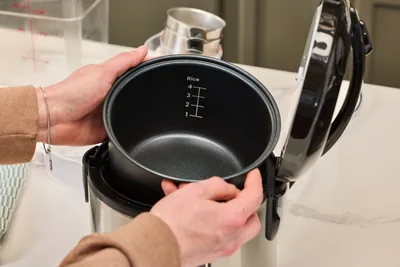
Imagine using the cooker several times a week. Consider how easily the lid opens beneath your cabinets, whether the pot can be removed comfortably, where condensation collects, and how many components need washing afterward.
Then examine the interface.
Frequently used settings should be easy to reach. Labels should be understandable without consulting instructions every time. Displays should remain readable from a normal standing position, particularly if the cooker sits below eye level.
Capacity and proportions matter too. A compact-looking cooker can still require significant clearance when its lid opens. Conversely, a wide appliance may provide a lower profile that works better beneath cabinets.
Finally, consider materials. The finish should tolerate repeated handling and cleaning, while removable components should feel durable enough for years of use.
These practical details separate attractive styling from genuinely effective product design.
Where Rice Cooker Design Is Heading
The next generation of rice cookers will likely continue moving in two seemingly opposite directions.
One path emphasizes sophisticated automation. Better sensors, pressure control, induction heating, cooking algorithms, and connected interfaces can give users finer control over rice texture while requiring less manual intervention.
The other path emphasizes simplicity. Products such as minimalist countertop cookers and non-electric designs demonstrate continuing interest in fewer controls, durable materials, and straightforward maintenance.
Both approaches can represent good design.
The common goal is reducing friction between the user and the food. Technology is valuable when it improves that relationship, not merely when it adds another feature to the specification sheet.
Rice Cooker Design Is About More Than Appearance
The most compelling examples of rice cooker design show how much engineering, ergonomics, materials science, interface design, and cultural context can exist inside an apparently simple kitchen appliance.
Zojirushi's ZUTTO demonstrated the lasting appeal of restrained design. BALMUDA reconsidered the cooking mechanism itself. Philips experimented with displays that visually disappear. Cuchen turned complex pressure-cooking technology into a softer sculptural object. Other designs have addressed sustainability, materials, cleanup, and leftover food.
Award-winning rice cookers don't all share one aesthetic because good design isn't a particular shape or style. It's the process of making dozens of decisions about how an appliance should look, work, feel, and fit into everyday life.
As rice cookers become more capable, that discipline becomes even more valuable. The standout designs won't simply offer more technology. They'll make increasingly sophisticated technology feel remarkably simple to use.