Customizable Rice Cookers: How They Work
A basic rice cooker has a straightforward job: heat rice and water until the rice is cooked, then switch to a warming mode. Customizable rice cookers take that familiar process and give the user more control over what happens before, during, and after cooking.
Depending on the model, that customization might mean choosing between soft and firm rice, setting a delayed start time, saving a preferred cooking program, or adjusting temperature and cooking duration manually. More advanced models can automatically modify a cooking cycle based on temperature readings and other sensor data.
The result is an appliance that doesn't treat every cup of rice the same way. Understanding how customizable rice cookers work can help you decide which features actually improve cooking and which ones you probably won't use.
What Is a Customizable Rice Cooker?
A customizable rice cooker is a rice cooker that allows some part of the cooking process or user experience to be adjusted beyond a single standard rice cycle.
There's no single technical definition of a "customizable rice cooker." Manufacturers use different terminology, including programmable, multifunction, smart, fuzzy logic, and induction heating rice cookers. The amount of actual control also varies considerably between products.
At the simpler end, customization consists of selecting preset programs for white rice, brown rice, or porridge. More sophisticated cookers may provide texture preferences, adjustable cooking times, temperature controls, timers, saved settings, and smartphone connectivity.
The key difference is control. Instead of making the user adapt every recipe to one cooking program, the appliance provides multiple ways to adapt the cooking process to the food.
How Customizable Rice Cookers Work
Most customizable models still rely on the same basic relationship among heat, water, and rice as conventional rice cookers. The difference lies in how precisely the appliance manages that relationship.
Heating the Inner Pot
The cooking process begins with a heating system transferring energy to the inner cooking pot.
Traditional models commonly use an electric heating element underneath the pot. Some higher-end rice cookers use induction heating, which creates heat within the compatible cooking vessel through electromagnetic induction. This can provide more responsive and even temperature control.
Once cooking begins, the water absorbs heat and eventually reaches a boil. Rice absorbs water as its starches hydrate and gelatinize.
As available water is absorbed or evaporates, conditions inside the cooker change. The appliance's temperature sensing system can use these changes to determine when the primary cooking stage should end.
Sensors Monitor Cooking Conditions
Sensors are one of the reasons modern rice cookers can provide more sophisticated cooking programs.
A simple cooker may primarily detect temperature changes associated with the water being depleted. More advanced machines can monitor temperature throughout the cooking cycle and adjust heating accordingly.
Instead of applying maximum heat until a fixed timer expires, the cooker may move through several stages. Depending on the selected program, these can include soaking, heating, boiling, steaming, resting, and warming.
That matters because rice preparation isn't simply a matter of reaching a particular temperature. How quickly the rice heats, how long it absorbs water, and how long it rests can all influence the final texture.
A Microcontroller Manages the Program
Programmable rice cookers generally contain electronic controls that manage the cooking cycle.
When you select "brown rice," for example, you aren't simply changing the label shown on the display. You're instructing the cooker to use a program designed for the different cooking characteristics of brown rice.
The programmed cycle may change the heating pattern, soaking period, cooking duration, or resting stage. Selecting another program can produce a different sequence.
This is what allows one appliance to accommodate foods with substantially different preparation requirements without requiring the user to manually switch the heating element on and off.
What Can You Customize?
Customization varies by model, so two appliances marketed as programmable rice cookers may provide very different levels of control.
Understanding the major types of customization makes comparing them easier.
Rice and Grain Programs
Preset cooking programs are the most common form of customization.
A cooker might include separate modes for white rice, brown rice, sushi rice, mixed rice, quinoa, oatmeal, or other grains. These aren't necessarily interchangeable because different grains absorb water and soften at different rates.
Brown rice retains its bran layer, for example, so it generally requires more water and a longer cooking process than polished white rice.
A dedicated program lets the appliance account for those differences automatically. This is particularly useful for households that regularly rotate between several types of rice and grains.
Texture Settings
Some customizable rice cookers let you specify how you want the finished rice to feel.
Options may include softer, regular, or firmer rice. The cooker can then modify parts of its programmed cycle to move the result toward the selected texture.
This type of setting is useful because "properly cooked" rice isn't one universal texture. Someone preparing rice for a particular dish may prefer a firmer grain, while another person may want softer rice for everyday meals.
Texture controls also make it easier for households to reproduce a preferred result without manually experimenting with cooking times every day.
They aren't magic, however. Water ratios, rice variety, rinsing, freshness, and measurement accuracy still influence the finished product.
Cooking Time and Temperature
Models that provide manual or semi-manual cooking modes can offer considerably more flexibility.
Instead of selecting only a manufacturer-designed rice preset, you may be able to change cooking duration or temperature for particular recipes. Some multifunction cookers extend this control to steaming, slow cooking, porridge, soups, or other foods.
Manual control is most useful for people who frequently experiment with recipes. For someone who cooks the same white rice every evening, extensive temperature adjustment may add complexity without much practical benefit.
Delayed Start
A delay timer doesn't change the physics of cooking, but it changes when the appliance begins the process.
You can prepare the cooker earlier and program it so the rice finishes closer to mealtime. That can be useful for households with predictable schedules.
Delay functions should still be used with food safety in mind. Leaving perishable ingredients sitting at room temperature for extended periods isn't appropriate simply because a cooker allows a delayed start.
The feature is generally better suited to ingredients that can safely remain in the cooker before cooking begins.
Keep-Warm Settings
Keep-warm functionality is common even on relatively simple rice cookers, but customizable models may provide greater control over it.
The appliance reduces heat after cooking so the rice remains warm without continuing to cook at the same intensity. Some models allow extended warming periods or provide different warming and reheating modes.
Temperature management becomes particularly important here. Too much heat can gradually dry or discolor rice, while inadequate temperature control can create food safety concerns.
A good warming function is therefore more than an on/off switch. It needs to maintain appropriate conditions while limiting further changes to the rice's texture.
How Fuzzy Logic Makes Rice Cookers More Adaptable
"Fuzzy logic" can sound like marketing language, but it refers to a real approach to control systems.
A conventional appliance can operate according to simple rules: if a particular condition occurs, perform a specific action. Fuzzy logic systems can make decisions using inputs that aren't treated as purely binary states.
In a rice cooker, this can help the control system respond to variations during cooking rather than following exactly the same heating sequence every time.
For example, actual cooking conditions can vary because of differences in ingredient quantities, starting water temperature, or environmental conditions. A cooker with more sophisticated electronic control can use sensor readings to modify parts of the cycle.
This doesn't mean the appliance literally understands that you accidentally added slightly too much water. It means its control system has more flexibility to respond to measured conditions.
The practical benefit is consistency. The user doesn't need to manage every small temperature adjustment manually.
Induction Heating Adds Another Level of Control
Induction heating is another feature commonly found in premium customizable rice cookers.
A conventional electric rice cooker typically transfers heat from a heating plate into the inner pot. An induction heating rice cooker uses an electromagnetic field to generate heat in the compatible pot itself.
This arrangement can allow more responsive temperature changes and distribute heating across a larger portion of the cooking vessel.
That responsiveness complements programmable cooking. If the appliance's control system decides that heat should increase or decrease at a particular stage, an induction system can respond efficiently.
Induction heating isn't necessary for making good rice, though. It generally increases the cost of the appliance, and many households will be perfectly satisfied with a well-designed conventional heating system.
Smart Rice Cookers and App-Based Customization
Some customizable rice cookers extend their controls beyond buttons on the appliance.
Connected models may use Wi-Fi, Bluetooth, or a companion app to provide remote controls, notifications, recipe programs, or scheduling features. Exact capabilities depend heavily on the manufacturer.
The practical question is whether connectivity makes cooking easier.
A notification telling you that a cooking cycle has finished can be genuinely useful if you're working elsewhere in the house. An app that provides access to additional programs may also appeal to someone who regularly experiments with different grains and recipes.
Connectivity introduces trade-offs, too. Apps can require accounts, software support may change, and a feature that depends on cloud services might not remain useful for as long as the physical cooker itself.
For a kitchen appliance that could last many years, strong onboard controls remain valuable even when smart functionality is included.
Can Customizable Rice Cookers Save Your Preferred Settings?
Some programmable appliances include memory or favorite functions that let users return to preferred settings more quickly. The exact implementation varies considerably.
Where available, saved programs can be useful for recipes that don't fit a factory preset.
Suppose you regularly prepare the same grain blend and have found a combination of cooking time and other settings that produces the texture you like. Saving those preferences reduces the need to recreate the setup each time.
This is where true customization becomes different from simply having lots of buttons.
Twenty fixed programs provide variety, but they're still choices designed entirely by the manufacturer. A smaller number of presets combined with adjustable and savable parameters may actually provide more meaningful control for an experienced home cook.
Presets vs. Manual Customization
More settings aren't automatically better. Presets are designed for convenience. You choose the food you're preparing and allow the cooker to handle the rest. This works well when the manufacturer's program closely matches the ingredient and result you want.
Manual customization shifts some responsibility back to the cook.
That provides flexibility, but it also creates more opportunities for error. If you can independently change time and temperature, you need some understanding of how those adjustments affect the food.
For many people, the best design sits between the two extremes. Strong presets handle routine cooking, while a limited set of adjustable parameters provides extra control when needed.
This approach keeps weekday rice simple without turning the appliance into a closed system that can't accommodate personal preferences.
What Customization Can't Fix
Even a sophisticated rice cooker depends on good preparation.
The appliance can't fully compensate for every incorrect rice-to-water ratio, and a specialized cooking program won't make two completely different rice varieties behave identically. Measuring ingredients consistently remains one of the easiest ways to improve repeatability.
Rinsing can matter as well. Washing rice removes loose surface starch and other residues, and the amount of rinsing can affect how the cooked grains behave. The appropriate preparation depends partly on the rice and the result you're trying to achieve.
Batch size also matters. Cooking below or above the manufacturer's recommended capacity can change performance.
Customization works best when you treat the machine as a precise cooking tool rather than as a device that automatically corrects every preparation mistake.
Are Customizable Rice Cookers More Energy Efficient?
Customization doesn't inherently make a rice cooker more energy efficient.
Energy consumption depends on factors including wattage, cooking duration, heating technology, insulation, batch size, and how long the appliance remains in keep-warm mode.
A sophisticated control system can manage heat precisely, but a longer specialized cooking program may also operate for considerably more time than a basic cycle. Likewise, leaving rice warming for many hours continues to consume electricity.
Capacity deserves attention as well. Buying a very large cooker for consistently small batches may not be the most practical approach.
Rather than assuming "smart" means efficient, compare the appliance's specifications and consider how you'll actually use it.
Who Benefits Most From a Customizable Rice Cooker?
The value of customization depends largely on how varied your cooking is. If you prepare one variety of white rice several times a week and are already happy with the results from a simple cooker, dozens of additional programs may offer little improvement.
Customization becomes more useful when a household cooks several rice varieties, whole grains, porridge, mixed-grain recipes, or other dishes that require different cooking conditions. Texture preferences can also justify additional controls if members of the household are particular about how their rice turns out.
Programmable scheduling can be valuable for people who organize meals around work or family routines, while manual controls tend to appeal more to cooks who enjoy experimenting.
The best feature set is therefore the one that matches the way you cook, not the model with the longest specification sheet.
What to Look for When Comparing Customizable Rice Cookers
Start by separating useful customization from feature count. Look closely at what can actually be changed. A cooker advertised with numerous menu options might provide dozens of fixed presets but very little manual control. Another might offer fewer programs while allowing meaningful adjustments to texture, cooking time, or temperature.
Consider the interface, too. Frequently used functions should be accessible without navigating confusing menus. A clear display, understandable labels, and easy-to-clean controls can matter more in daily use than an obscure specialty mode.
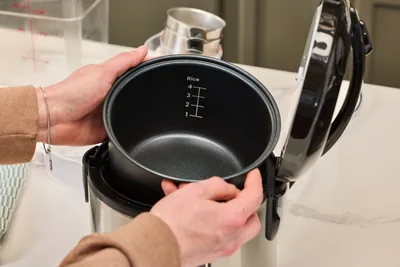
The inner pot deserves equal attention because its construction affects heat transfer, durability, weight, and cleaning. Capacity should match the quantities you normally cook rather than the largest meal you can imagine preparing.
Finally, think about longevity. If core cooking functions depend heavily on an app, ask whether you'd still be happy using the cooker if its connected features eventually became unavailable.
Are Customizable Rice Cookers Worth It?
A customizable rice cooker is worth considering when its adjustable features solve an actual cooking problem.
If you frequently switch among white rice, brown rice, mixed grains, oatmeal, and other foods, dedicated programs can eliminate repeated guesswork. If you're particular about texture, adjustable settings can make it easier to reproduce the consistency you prefer.
Timers and programmable functions can also make the appliance fit more naturally into a household routine.
Paying extra for customization you won't use provides much less value. The goal isn't to buy the rice cooker with the most modes. It's to find one that gives you useful control without making a simple task unnecessarily complicated.
Getting More From Customizable Rice Cookers
Customizable rice cookers work by combining the basic rice-cooking process with sensors, electronic controls, specialized programs, and, in some models, induction heating or connected features. These technologies allow the appliance to vary how it heats, rests, and warms food according to the selected settings.
The most useful customization is often surprisingly practical: choosing the right program for a grain, adjusting the finished texture, scheduling cooking around dinner, or saving settings that consistently work for a favorite recipe.
More advanced technology can improve precision, but it doesn't replace proper measurements or good ingredients. The strongest customizable rice cookers strike a balance. They automate the parts of cooking that benefit from consistency while leaving enough control for you to decide how you want the finished food to turn out.